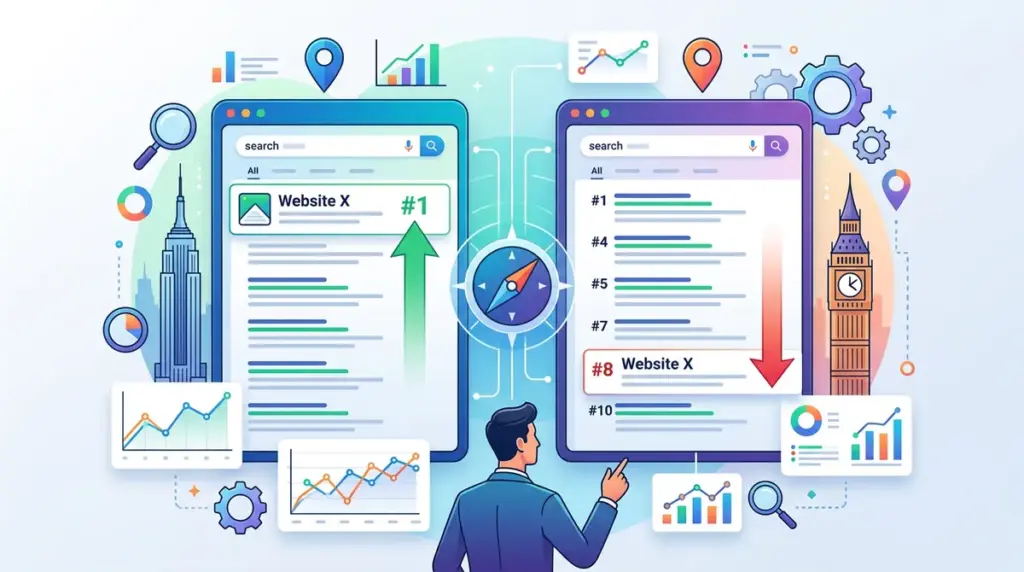
Tracking keyword rankings without specific location parameters is like reading a map of the wrong city. For any business operating in a physical space or targeting specific regional demographics, a "national average" rank is a vanity metric that obscures the actual user experience. Google’s search results are no longer a static list; they are a dynamic response to the searcher’s IP address, GPS coordinates, and local search history. If your rank tracking tool isn't configured to mimic these specific variables, the data you are reporting to clients or stakeholders is fundamentally inaccurate.
The Proximity Factor and SERP Volatility
Google’s algorithm prioritizes proximity, especially for queries with local intent. When a user searches for "commercial insurance" in Chicago, the results differ significantly from the same search performed in Houston. This isn't just about the Local Pack or the "Map Pack"—it extends to the organic blue links as well. Localized search settings allow you to see exactly which regional competitors are displacing you in specific markets.
Best for: Multi-location service providers, regional retailers, and SEO agencies managing franchise accounts.
Without granular location settings, you might see a steady "Position 3" ranking globally, while in reality, you are in Position 12 in your most profitable market. This discrepancy occurs because Google adjusts the weight of backlink profiles versus local relevance based on where the search originates. Accurate rank tracking must account for these shifts to provide a realistic view of market share.
Hyper-Local Tracking: Zip Code vs. City Level
The level of granularity you choose determines the utility of your data. For many industries, city-level tracking is insufficient. In densely populated urban areas, search results can fluctuate between neighborhoods or even specific zip codes. This is particularly true for high-competition keywords in the legal, medical, and home services sectors.
- Zip Code Tracking: Essential for businesses that rely on immediate physical proximity, such as emergency plumbers or urgent care clinics.
- City Level Tracking: Suitable for B2B services or e-commerce brands with regional distribution centers.
- State/Province Level: Useful for monitoring regulatory or legislative content that applies to a specific jurisdiction.
- Language-Specific Location: Critical for multi-lingual regions where the search intent changes based on the localized language settings of the browser.
The Impact on Search Intent and SERP Features
Location settings don't just change the order of links; they change the layout of the entire page. A search for "best coffee" in a residential neighborhood will likely trigger a Map Pack and Yelp reviews. The same search performed from a business district might prioritize "best coffee for offices" or delivery services. By setting your rank checker to specific coordinates, you can identify which SERP features—such as People Also Ask, Local Packs, or Image Carousels—are dominating the screen real estate in that area.
Warning: Relying on a standard VPN to check local rankings is often ineffective. Google can frequently detect VPN exit nodes and may serve "neutralized" results or trigger CAPTCHAs, which do not reflect the authentic experience of a local user with a clean browser history and verified GPS data.
Identifying Competitor Displacement in Regional Markets
National brands often find themselves outranked by smaller, local players who have optimized for specific geographic signals. If you are a national brand, location-based rank checking allows you to identify these "local heroes" and analyze their strategy. Do they have more localized landing pages? Is their Google Business Profile more active? You cannot counter a local competitor if you don't know they are beating you in their home turf.
Conversely, for small businesses, local rank tracking is the only way to prove the ROI of localized content marketing. If you spend three months optimizing a "Denver Law Firm" landing page, a national rank tracker will show zero progress because you aren't ranking in New York or Los Angeles. Only by filtering for Denver-specific results can you demonstrate the growth in visibility to the target audience.
Eliminating False Positives in Reporting
SEO reporting is often plagued by "false positives"—instances where a keyword appears to be ranking well but is actually failing to drive conversions because it is ranking in the wrong place. For example, a real estate agency in Florida does not benefit from ranking #1 for "homes for sale" in Oregon. If your rank checker is set to a broad national setting, those irrelevant rankings clutter your reports and inflate your perceived performance.
By narrowing the search location, you filter out the noise. You ensure that every "Position 1" you report is a position that actually has the potential to generate a lead or a sale. This precision builds trust with clients who are looking for bottom-line results rather than abstract SEO metrics.
Configuring Your Localized Tracking Strategy
To implement an effective localized tracking strategy, you must first audit your traffic sources in Google Analytics. Identify the geographic regions that drive the highest conversion rates and prioritize those for granular tracking. Do not waste your crawl budget or tracking limits on regions that do not contribute to your business goals.
Once you have identified your key markets, configure your rank checker to monitor your primary keywords across those specific locations. Compare the data. If you notice a significant gap between your performance in two different cities, it indicates a need for localized content or a more aggressive local backlink strategy in the underperforming area.
Common Variables Affected by Location Settings:
- The Local Pack: The three-map listing that appears at the top of the SERP.
- Language Preferences: Results served in Spanish vs. English in markets like Miami or Los Angeles.
- Mobile vs. Desktop: Location data is often more precise on mobile, leading to even greater SERP variance.
- Ad Placement: Local Service Ads (LSAs) and standard PPC ads change based on the searcher's location.
Audit Your Regional Visibility Now
Stop reporting on generalized data that doesn't reflect the reality of your market. Begin by selecting your top five revenue-generating cities and setting up dedicated tracking for each. Analyze the difference between your "Global" rank and your "Local" rank. This gap represents your immediate opportunity for optimization. Use these insights to refine your on-page SEO, update your local citations, and tailor your content to the specific needs of each geographic audience. Precision in tracking leads to precision in strategy, which ultimately leads to higher conversion rates and better ROI.
Frequently Asked Questions
Why does my rank checker show a different result than my manual search?
Manual searches are influenced by your personal search history, logged-in Google account, and specific browser cookies. A rank checker uses a "clean" environment and specific IP/GPS spoofing to simulate a new user in that exact location, providing a more objective view of the SERP. Using a dedicated tool helps you monitor keyword positions accurately, bypassing personal biases.
Does tracking multiple locations count as multiple keywords?
In most professional tools, tracking one keyword in two different locations counts as two separate tracking units. This is because the tool must perform two distinct scrapes of the search engine results pages to provide accurate data for each locale.
How often should I track local rankings?
For highly competitive local niches (like locksmiths or lawyers), daily tracking is recommended due to high SERP volatility. For B2B or less "immediate" industries, weekly tracking is usually sufficient to identify trends without over-consuming data limits.
Can location settings affect my featured snippet rankings?
Yes. Google often tests different featured snippets for the same query in different regions to see which one gets a better click-through rate. Tracking by location allows you to see if you have "won" the snippet in your primary markets even if you haven't secured it nationally.