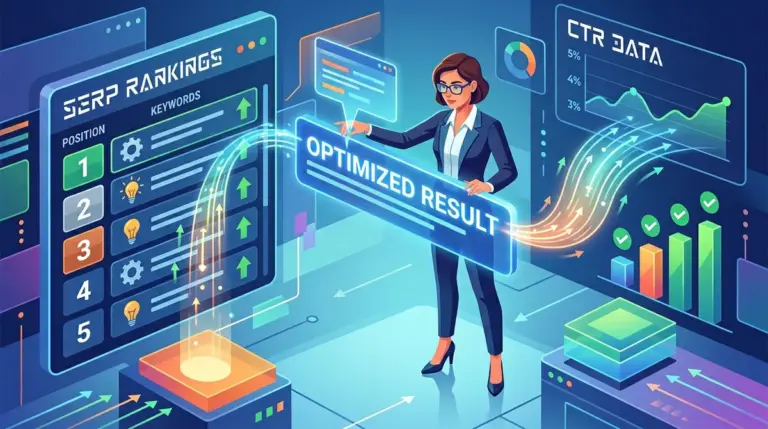
In modern SEO, a number one ranking is no longer a guarantee of traffic. For years, the industry operated on a linear assumption: higher rankings equal more clicks. However, as Google transitions from a search engine to an "answer engine," the relationship between position and click-through rate (CTR) has decoupled. You can own the top spot for a high-volume keyword and still see your traffic plateau or plummet. Understanding why this happens is the difference between chasing vanity metrics and driving actual revenue.
The Rise of Zero-Click Searches and SERP Crowding
The primary reason a high ranking fails to convert into a click is the evolution of the Search Engine Results Page (SERP) layout. Google now prioritizes immediate gratification through various "Zero-Click" features. When a user finds their answer directly on the results page, they have no incentive to visit your website.
Featured Snippets and Knowledge Panels
If your content answers a "What is" or "How to" query, Google may extract that text into a Featured Snippet. While this provides massive brand exposure, it often satisfies the user’s curiosity immediately. Similarly, Knowledge Panels for entities, brands, or public figures aggregate data from multiple sources, effectively killing the need for a user to click through to a secondary source.
The Local Pack and Map Dominance
For any query with local intent—such as "plumber near me" or "best coffee shop"—the organic results are pushed significantly "below the fold." The Local Pack (the map with three listings) occupies the most valuable real estate. Even if you are the #1 organic result, you are effectively in the 4th or 5th visual position, trailing behind three local businesses and potentially several Google Ads.
Warning: High-volume informational keywords are increasingly becoming "dead ends" for traffic. If your target keyword triggers a calculator, unit converter, or a detailed People Also Ask (PAA) drop-down, expect your CTR to be 50-80% lower than historical benchmarks for that position.
Search Intent Mismatch: The Silent Conversion Killer
Ranking for a keyword does not mean you have satisfied the user’s underlying need. Google’s algorithms are sophisticated enough to rank a page based on topical authority, but users click based on intent alignment. If there is a disconnect between what the user wants and what your snippet promises, they will skip over you.
- Informational vs. Transactional: A user searching for "best CRM features" is looking for a guide or comparison. If your ranking page is a direct "Buy Now" product landing page, the user will likely bypass it in favor of an editorial review.
- Format Mismatch: If the SERP is dominated by video results or image carousels, a long-form text article—no matter how well-ranked—will struggle to capture attention.
- Temporal Relevance: For news-sensitive or seasonal queries (e.g., "SEO trends 2024"), a result that looks outdated in the title tag will be ignored, even if it holds the top spot.
The Impact of Aggressive Paid Search Placement
In competitive commercial niches, the "top" of the page is a relative term. Google often displays four text ads at the top, followed by a Shopping carousel. In these scenarios, the #1 organic result is physically located in the middle of the screen or requires a full scroll on mobile devices. This "ad heavy" environment creates a psychological barrier where users perceive the first few results (the ads) as the most relevant, or simply get "ad fatigue" and skim past the first organic result looking for a specific brand name.
Metadata Failures and Lack of Visual Cues
Your title tag and meta description are your "sales pitch" on the SERP. If they are poorly optimized, you are essentially a high-end product in a plain brown box. Common mistakes that suppress clicks include:
Truncated Titles: If your title is over 60 characters, Google will likely cut it off. If the most compelling part of your USP is at the end of that string, the user never sees it.
Generic Descriptions: Using the same meta description across multiple pages or failing to include a call to action (CTA) makes your result blend into the background. Users are looking for specific triggers like "Free Shipping," "Step-by-Step Guide," or "Data-Backed."
Missing Rich Snippets: Results that utilize Schema Markup (stars, prices, stock status, or recipe times) occupy more vertical space and provide visual "social proof." A #3 result with 5-star review snippets will almost always outperform a #1 result that is just plain text.
Brand Bias and User Trust
Users often exhibit "Brand Navigational" behavior. Even if an unknown site ranks #1, a user may skip down to #3 or #4 if they recognize a household name like Amazon, New York Times, or HubSpot. Trust is a powerful click driver. If your brand is unknown in a high-stakes niche (like finance or health), you must work twice as hard with your metadata to prove your credibility and authority to earn that click over a legacy competitor.
Auditing Your Click-Through Rate Gap
To fix a ranking-to-click disconnect, you must identify where the leak is occurring. This requires moving beyond simple rank tracking and looking at the "SERP landscape" for your primary keywords.
Best for: Identifying underperforming pages by comparing Search Console CTR data against industry averages for specific positions. If your #1 spot is getting less than 15% CTR, you have an optimization problem.
To improve your results, focus on these three levers:
1. Title Tag Engineering: Use brackets (e.g., [Case Study]) or current years to increase relevance. Experiment with "Power Words" that promise a specific benefit.
2. Schema Implementation: Deploy FAQ, Review, or Product schema to maximize your physical footprint on the page.
3. Intent Correction: Re-examine the top 5 results. If they are all lists and you have a landing page, rewrite your content to match the format Google clearly prefers for that query.
Strategic Adjustments for Better Traffic
Stop measuring success by the average position alone. A site that ranks #3 for a keyword with no SERP features will often generate more revenue than a site ranking #1 for a keyword buried under ads and snippets. Shift your focus toward "Share of Search" and visual prominence. By optimizing for the click rather than just the rank, you ensure that your SEO efforts translate into actual site visitors and, ultimately, customers.
FAQ
Why is my CTR so low even though I am in the top 3?
This is usually caused by SERP crowding. Check if there are four ads at the top, a Featured Snippet, or a "People Also Ask" box. These elements push organic results down and satisfy the user's intent without requiring a click.
Does Google use CTR as a ranking factor?
While Google has been vague about this, many SEO professionals believe that "pogo-sticking" (clicking a result and immediately hitting back) and low CTR relative to position act as signals that a page may not be the best fit for that query, potentially leading to a rank decline over time.
How can I see which of my keywords have the worst CTR?
Use Google Search Console's Performance report. Filter for your top-ranking keywords (Position < 3) and sort by CTR in ascending order. This will highlight the pages where you are winning the ranking battle but losing the click battle.
Can I "win back" clicks from a Featured Snippet?
Yes, by optimizing your metadata to pique curiosity. If your snippet provides the full answer, the user won't click. If your snippet provides a partial answer or a summary that suggests more detail is available on the page, you can maintain the snippet and the traffic.