
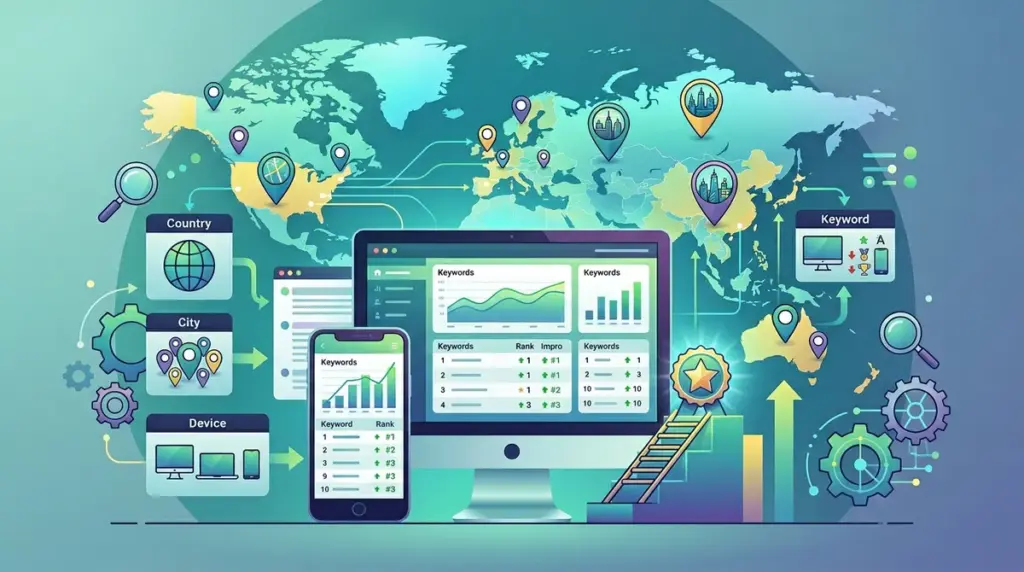
Global search volume is a vanity metric if your business relies on local conversions. A top-three position in a nationwide report often masks the reality that your site is invisible in the specific cities where your customers live. Search engine results pages (SERPs) are no longer static lists; they are dynamic environments shaped by the user’s physical coordinates, the hardware in their hand, and the language settings of their browser. To capture accurate data, you must move beyond aggregate averages and track rankings at the granular level of country, city, and device. This is especially true when you consider how Google prioritizes results for near me keywords based on user location.
The Mechanics of Hyper-Local Rank Tracking
Google uses a combination of IP addresses, Wi-Fi triangulation, and GPS data to serve results. For an SEO professional, this means a "near me" query or even a broad industry term like "commercial insurance" will yield different results in Austin than it does in Dallas. If your tracking tool only monitors at the country level, you are seeing a blended average that doesn't exist for any real user.
Best for: Multi-location service businesses, franchise brands, and e-commerce sites with regional pricing or availability.
To implement effective city-level tracking, you must configure your rank checker to simulate specific zip codes or neighborhoods. This is particularly critical for the Local Pack (the map results), which often occupies the most valuable real estate above the fold. Tracking at the city level allows you to identify "blind spots" where competitors are outranking you due to proximity or local relevance signals that don't appear in national audits.
Managing Device Disparity in the Mobile-First Era
Desktop and mobile SERPs are distinct ecosystems. Since the completion of mobile-first indexing, Google primarily uses the mobile version of a site's content for indexing and ranking. However, the actual layout of the SERP varies significantly between devices. Mobile screens prioritize local packs, image carousels, and "People Also Ask" boxes, often pushing organic blue links far down the page.
Tracking by device is necessary because:
- Layout differences: A rank of #4 on desktop might be "above the fold," while on mobile, it requires three swipes to reach.
- Feature volatility: Featured snippets and AI Overviews appear more frequently or in different formats on mobile devices.
- Speed as a ranking factor: Mobile rankings are more sensitive to Core Web Vitals and page load speeds over cellular networks.
- User intent: Mobile searches often have higher local intent ("where is...") compared to desktop searches which may be more research-oriented.
Warning: Do not rely on a standard VPN to check local rankings manually. Google identifies most commercial VPN exit nodes and may serve "neutral" results or trigger CAPTCHAs, which do not reflect the authentic experience of a local user. Use a dedicated rank tracker that utilizes residential proxies or localized API requests.
Configuring Rankings by Country and Language
For international SEO, the country is the first filter, but language is the second. Tracking rankings in Switzerland, for example, requires monitoring results in German, French, and Italian. Each language version of the SERP is a different competitive landscape. When setting up your tracking, ensure you are matching the hl (host language) and gl (geographic location) parameters used by Google.
This level of detail prevents "false positives" in your reporting. You might see a ranking increase in a global report, only to realize later that you are ranking for a low-intent translated term rather than the primary commercial keyword in the target country’s dominant language.
The Role of GPS Coordinates in High-Precision Tracking
In highly competitive local markets—such as real estate or legal services—tracking by city is sometimes too broad. Modern SEO requires tracking by specific latitude and longitude. This allows you to see how your visibility "heat map" expands or contracts around your physical office or storefront. If your rankings drop off sharply three blocks away from your location, it indicates a need for stronger local citations and localized content clusters to build geographic authority. For businesses with a broad geographic reach, understanding this granular data is key to tracking multiple locations at scale effectively.
Technical Implementation for Agencies
Agencies managing multiple clients must automate this process to remain profitable. Manual checking is impossible at scale. When selecting or configuring a tracking solution, prioritize tools that offer:
API Access: For pushing granular data into custom Looker Studio or PowerBI dashboards.
Frequency Control: Daily updates are necessary for volatile local markets, while weekly updates may suffice for stable national keywords.
SERP Snapshots: Visual proof of what the user actually sees, including ads and local extensions, which provides context that a simple "Rank 5" number cannot.
Executing a Segmented Tracking Strategy
To turn this data into revenue, you must segment your reporting. Stop sending clients a single "Average Position" metric. Instead, break your reports down by "Mobile Visibility in London" versus "Desktop Visibility in Manchester." This transparency allows you to justify specific technical interventions, such as optimizing mobile CSS for a specific region or building localized landing pages for cities where organic reach is lagging.
Focus on the delta between devices. If your desktop rankings are consistently higher than mobile, it is a technical signal that your mobile UX or site speed is throttling your performance. Conversely, if you rank well on mobile but poorly in the local pack, your Google Business Profile (GBP) optimization and local citation consistency need immediate attention.
Common Questions Regarding Localized Tracking
Does searching from my own phone give an accurate rank?
No. Your personal search history, logged-in Google account, and past clicks heavily bias the results you see. This is known as "personalized search." To see what a new customer sees, you must use a third-party tool that queries the SERP via a clean, non-personalized browser environment localized to the target coordinates.
Why do my rankings change when I move from one side of the city to the other?
Google’s "Opossum" update and subsequent local algorithm refinements increased the importance of the user's physical proximity to the business. In densely populated areas, the "service area" of a local result can be as small as a few miles. This is why tracking by zip code or GPS is superior to tracking by city name alone.
Can I track rankings for different languages in the same city?
Yes. This is essential for multicultural hubs like Miami, Los Angeles, or London. You should set up separate tracking tasks for the same keyword in different languages (e.g., "lawyer" vs. "abogado") to understand how search intent and competition shift across different demographic segments within the same geographic area.
Is mobile-first indexing the same as mobile-only ranking?
No. While Google uses the mobile version of your site for indexing, it still maintains separate algorithms for how results are displayed on desktop. Desktop users may see more sidebars, different ad placements, and more extensive knowledge panels. You must track both to ensure you are capturing the full breadth of your potential traffic.